
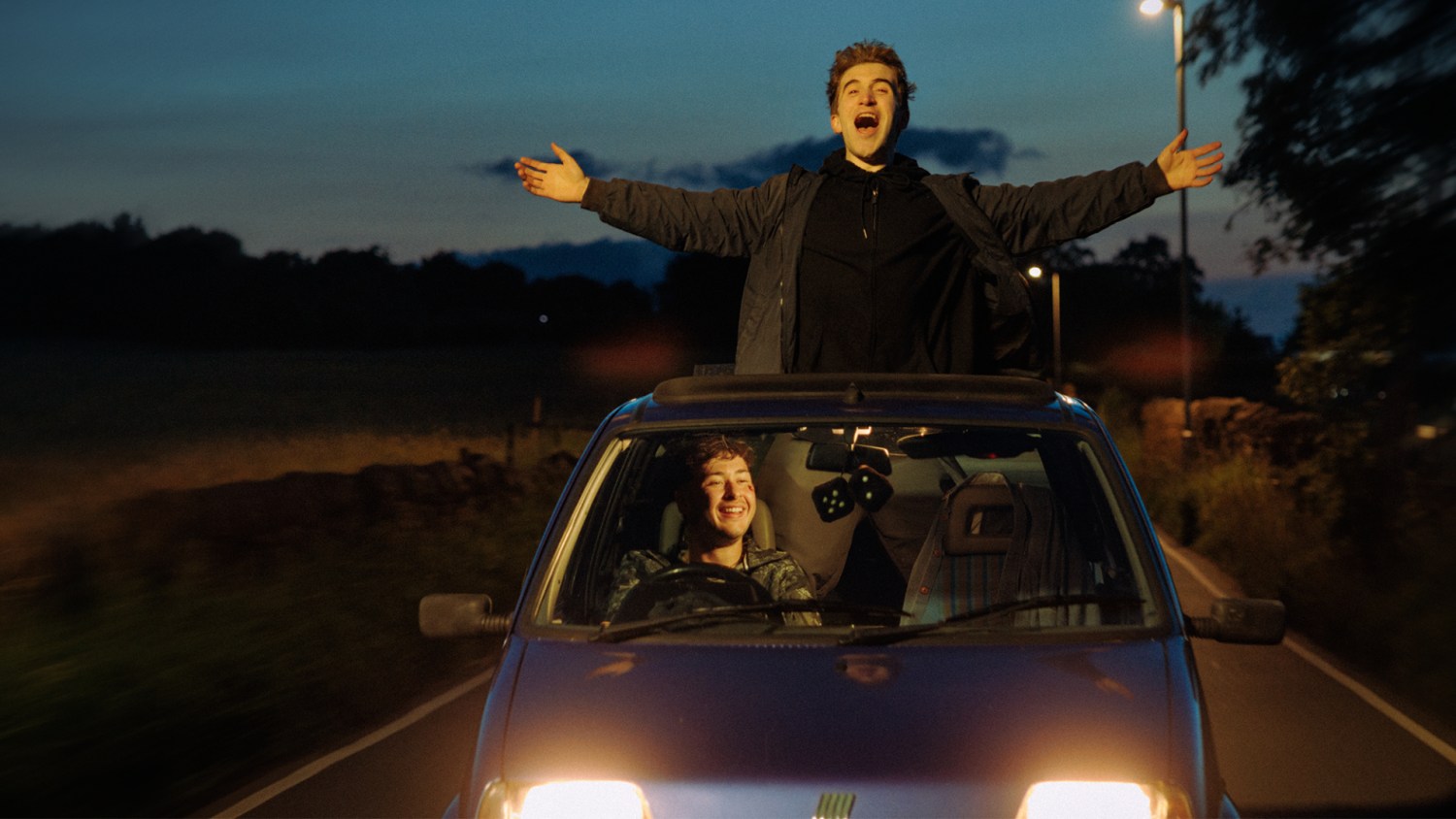
In the subgenre of the big night out film, Superbad - Human Traffic, there is rarely purposefully comment on serious topics. Subverting this, The State of Us brings an authentic emotional tone to the night out it follows. Frankie, a confident and reckless young man breaks his friend and foster brother Taylor out of a hospice to embark on a wild anniversary. The two have polar opposite views on life, on respecting yourself and others. But are drawn closer as they embark on a planned journey of debauchery.
The final showing of the State of Us is on Tuesday the 18th at Edinburgh Cineworld. Touching and non-pretentious, it is a highlight of the programme.
I first wanted to ask about the narrative structure. It all takes place in one night, but then you have flashbacks. Was that from the very start?
Jake:
Yeah, the structure has remained largely the same. The original script had the full flashback sequence at the start, and I think we debated early on that we wanted to chop it up. Because as soon as you're with Frankie on the break-in, that's the electric journey, wild ride that you want to be on. When I was writing it, I wanted it to be an out-and-out comedy from the get-go, because I think that's what engaged people emotionally. And then it was to build this love story through Act 2, and show what these boys actually mean to each other. And then I'd say Act 3 is sort of an out-and-out drama with a little plot in the middle.
Harvey:
The flashbacks were the hardest thing to piece in, because you realise in the film that you're experiencing it through Frankie's experience and his lens, so it became "how can we get the audience into the mind of Frankie?" because we're giving too much away if we show everything at the start. It's more interesting for us to be piecing this along as we experience Frankie going through the night, and it's also that we had to earn the right to understand where he was coming from, otherwise we're answering the question too early. It became quite a jigsaw to work out how to do that.
And what was it like to combine those comedic aspects with the more serious notes about terminal illness and growing up?
Jake:
The slightly dark answer is that when you hear how young men speak there's a lot of scope for how they deal with the stress and the anxieties around the grief and the darkness that they're facing, and I think that it felt true to my experience with young lads and what you go through, that you have to earn the right to be emotional before you can actually be emotional and be vulnerable with each other. And I think the comedic element not only felt authentic, but it also feels like it hopefully speaks to the audience, which should be young men.
Harvey:
I think everyone, not just young men, find it hard to just dive straight in with really emotional, really big topics that are incredibly triggering. We wanted to veer away from anything that felt too perfect or too articulate. Little snippets where you can see Frankie wanting something more, you can see him bat something away. Then build that emotional tension as you go along with the film.
The two main characters have a really good chemistry, what was the process of casting like and building that?
Harvey:
We found Sam quite early on, and we were immediately was like "This is Frankie". And we knew that the film lived or died with the chemistry of these two lads. We had some amazing actor in that audition space, but when Callum then came in, there was an instant connection, not only between those two, but between all of us. And we've said that all along, this is a film about two best mates made by two best mates. So we knew that all four of us needed to have that chemistry in order to work, and so when we had it in abundance, I think we knew it was going to work very, very early on.
Jake:
One of the best things about Sam and Callum is they are genuinely normal lads, and they're totally ego-less. Their first instinct was to ask us about where the story came from, give their own interpretations of the character's friendship groups and their struggles. I think as soon as you have that going around the team, you're instantly in a safe space to really push each other to access the emotional side of it.
And the narrative kind of introduces elements and then ties it up all together at the end, was that something that was important to include?
Jake:
In the first draft of the script I wrote, I would say only the first act has stayed the same. The rest has changed, other than their argument on hilltop. What I really wanted to tackle was is what does a man, or anyone who has put in a position, do with the very little days left in their life. And it's not Taylor's choice, but he sees more beauty in those few days than his best friend who has his whole life ahead of him.
Harvey:
I think the ending, the very last shot, became quite a discussion point. Because what do you want the audience to leave with? I think the one we landed on felt A, the most organic, but it also felt like you let the audience sit with it for a bit, and how much do you want to give away or tell. he audience is incredibly intelligent and clever, and I like piecing something together and pulling it out, and I think we tried to find pockets of that in this film, so you really felt like you were going on a journey. So the ending is much more emotional and sit in it, rather than try to over-intellectualise anything.
Jake:
What we wanted people to leave the cinema thinking of their best mate. And I think that's exactly the way that Frankie leaves, equipped with the tools to move on in his life and become a better person.
Throughout the film there's some nice glimpses of the location, the nature. There's also a lot of the town and the hospital, to what extent do you think it's tied to that location in the north of England?
Harvey:
I mean, the story is about two lads, two British lads, but it could be any two British lads from any region. There was various reasons we wanted to take it to Bradford, and a big one was that a lot of the stories we were starting to see were very London-centric. Some of our favourite films that we were inspired by at the beginning were these amazing northern stories, and there was a nostalgia for that, and a warmth.
Jake:
But also when we found Sam, who is a born-and-bred Bradford lad, it felt like "Why are we trying to put them anywhere else?" It's his story, let's lean into that. He loved showing us around Bradford, he felt really proud of that. The people of Bradford were amazing to us, and the crews were incredible, and the landscape had these beautiful sweeping hills, and it also had this really industrial town to it, so it felt like the right friction on what the film was about as well.
Harvey:
We always said we wanted to find somewhere that has a natural landscape that's beautiful, and has a grittier edge, because that's Taylor's interpretation of his hometown, and that's Frankie's. So as soon as it was unlocked with the locations team, who I'd worked with before previously, it was like "This is our place."
Jake:
And Bradford came as such a character to the film, we were amazed at what isn't on the page and what comes to such a character. like the car, which is such a character. It's tattooed on our arms. Somewhere, the car became such a feature, the landscape became such a feature, these are things that on the page you can't possibly write them in... but the locations became such a character to the piece, and really gave it a really special edge.